![[good]men: works > in > progress](https://substackcdn.com/image/fetch/$s_!yeC6!,w_120,h_120,c_fill,f_webp,q_auto:good,fl_progressive:steep/https%3A%2F%2Fsubstack-post-media.s3.amazonaws.com%2Fpublic%2Fimages%2F7f1138b2-fde1-461d-afea-95b2066e2dbc_1077x1077.png)
Listening to Yourself
Rather than rushing to fix anything.

Reading Time: 6 minutes, 783 words. Ideas inspired by the “[good]men | works > in > progress.” initiative. Read backstory here + Subscribe for free:

Trail Testing “works > in > progress“
This past Saturday, (12) men arrived at the trailhead for a “[good]men: works > in > progress” experience.
Energy, high. Curiosity, even more so.
A few of the guys recognized each other. Most only knew me, their host and guide. Beyond that, all they knew was that they had accepted an invitation to spend half a day hiking a 5-mile forest trail with men they’d never done this with before while collectively exploring various “works > in > progress” happening in their lives.
Their pre-hike homework: identify 2-3 of their own real-life “works > in > progress” that they wanted to explore with purpose while on the trail. Examples are limitless. But we suggested an easy place to start:
choose “works > in > progress” outside oneself: career, hobby, exercise, house, gardening, planning an upcoming adventure, project, future retirement, community service, etc. *and/or*
choose “works > in > progress” inside oneself: identity, emotions, values, marriage, relationships, faith, confidence about ____, sense of aging, belief systems, comfort with others, etc.
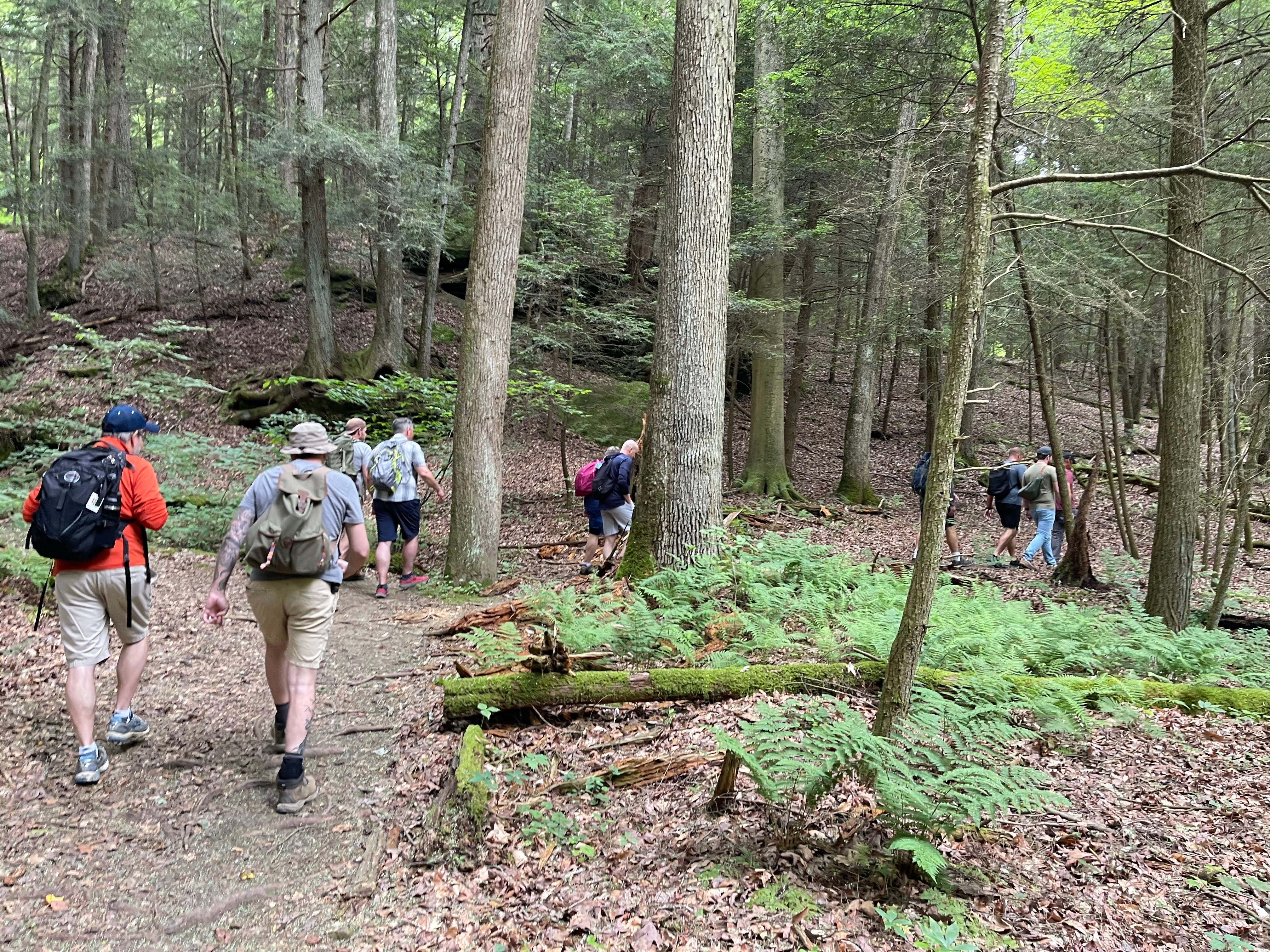
The on-trail process that I share:
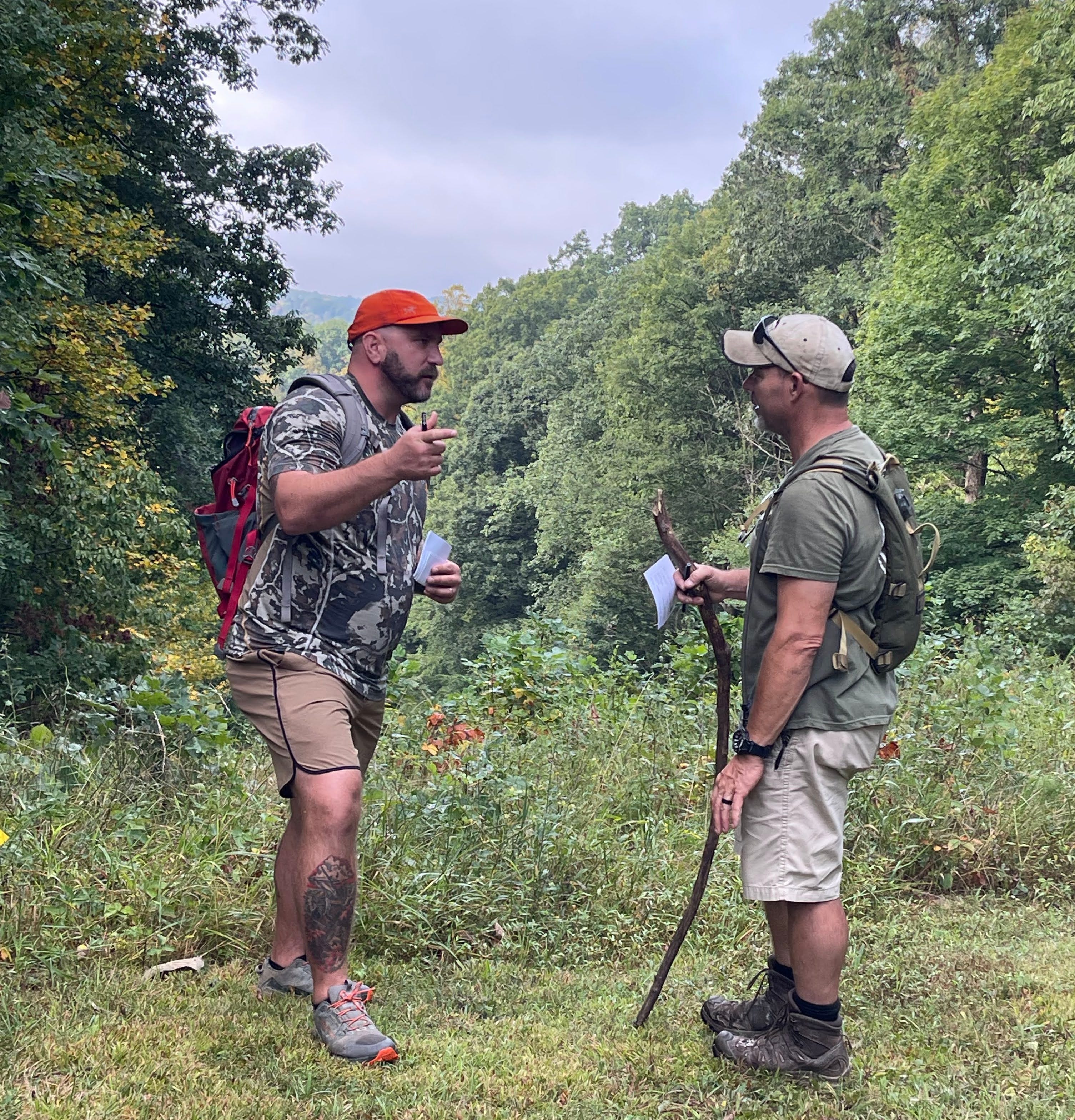
For the first half of the day’s experience, each man partners with several different men for 20-minute 1-on-1 conversations while hiking. Pairs are pre-selected to offer a diverse set of dialogues and perspectives.
A conversation gives each man 10 minutes to share one of his “works > in > progress” with his partner. Give a bit of context. Add detail. Some sense of what “in > progress” means to him at this moment. Offer why this particular “work” has value.
The partner’s primary job is to listen with curiosity and help the speaker ‘say more’ about his chosen “work > in > progress”. Best way to do all three? Ask non-leading questions (aka: “Have you thought about…”). Or simply say, “Tell me more about _____.” Sometimes the best move is to just remain silent, letting the storytelling partner fill in their own quiet spaces along the way.
“Remember that people don’t really want answers. They want powerful questions that allow them to discover their own answers.”
Dan Sullivan, co-founder, Strategic Coach
Rule no1: Do Not Fix
This is the only rule we stress:
Do not fix. Or…
Do not solve. Or…
Do not even advise.
Easy to suggest. Easy to ‘agree to try’.
Also: amazingly difficult to do.
But there’s a reason we stress this expectation on our hikes…
Hearing Oneself For the Very First Time
When we see someone’s unique telling of one of their “works > in > progress” as an opportunity to offer advice, share recs, or add our own story to their story, we force them to stop.
It might come from empathy. It may be very well intentioned. It might be super useful and technically sound. It might even be legit wisdom.
But our partner will go quiet. And our partner will stop making progress.
Or they get defensive, stuck between what they know and what we are telling them. Reacting. Not reflecting.
Or they lose track of the very thing that they’re working towards, the thing they are telling us about.
Or worse, they begin to let go of the very thing that led to our well-intentioned advice, no longer feeling that their “works” are worth making “progress” on. After all, we’ve already done the hard work and solved for them. They are no longer in “process”.
So we set up each pair of men with one rule: do not solve the other man’s challenge. This changes everything.
The hidden power of having a genuinely committed listening partner is the rare opportunity to hear oneself.
Perhaps for the very first time.
All too often, we’re a scripted storyteller when we start talking.
We’ve told this story before. In our head or in other company. A familiar telling. A predictable combo of facts and challenges. Loaded with assumptions. Already impossible to explore or re-imagine. Packaged for quick and superficial conversation, a weather report, lacking a hint of the depth that’s really being felt.
But when our partner listens, lets us pause without filling in the gaps, leans in with deep curiosity, asks us to “say more”, and offers zero pressure to easily solve anything, we start to say what we’ve never said before.
We begin to listen. To ourselves.
Perhaps for the very first time.
“There’s always something in us that’s saying, You’re not quite on the right track here. Or you’re on the right track but you need to dig deeper for the courage to take the next step. There’s a voice in us that’s trying to guide us.”
Parker Palmer, “The Growing Edge” podcast; Ep 51, “All Real Living is Meeting”
Thank You
Countless folks have helped me better understand how “[good]men” can purposefully explore + manage life’s many “works > in > progress”.
Appreciate you reading, subscribing to, and sharing this journal.
And please reach out at christian [@] bonfire-workshop [.] com if you’d ever be up for joining “[good]men: works > in > progress”on trail, in a retreat, by a campfire, or online; sign up for executive coaching sessions; or co-create experiences for others.
Cheers, Christian
P.S. “[good]men. | works.in.progress.” backstory can be read here.
And as always, you can subscribe — for free — to this journal here:
Loved reading this. Thanks for sharing!!
Being in nature provides a serene backdrop to truly listen and connect with someone. By offering empathetic silence rather than advice, you create a safe space for the other person to explore their thoughts and find their own path forward. You’re creating a space where all of this can unfold, and the ripple effect will be profound.